The Sociology of Islam by Armando Salvatore
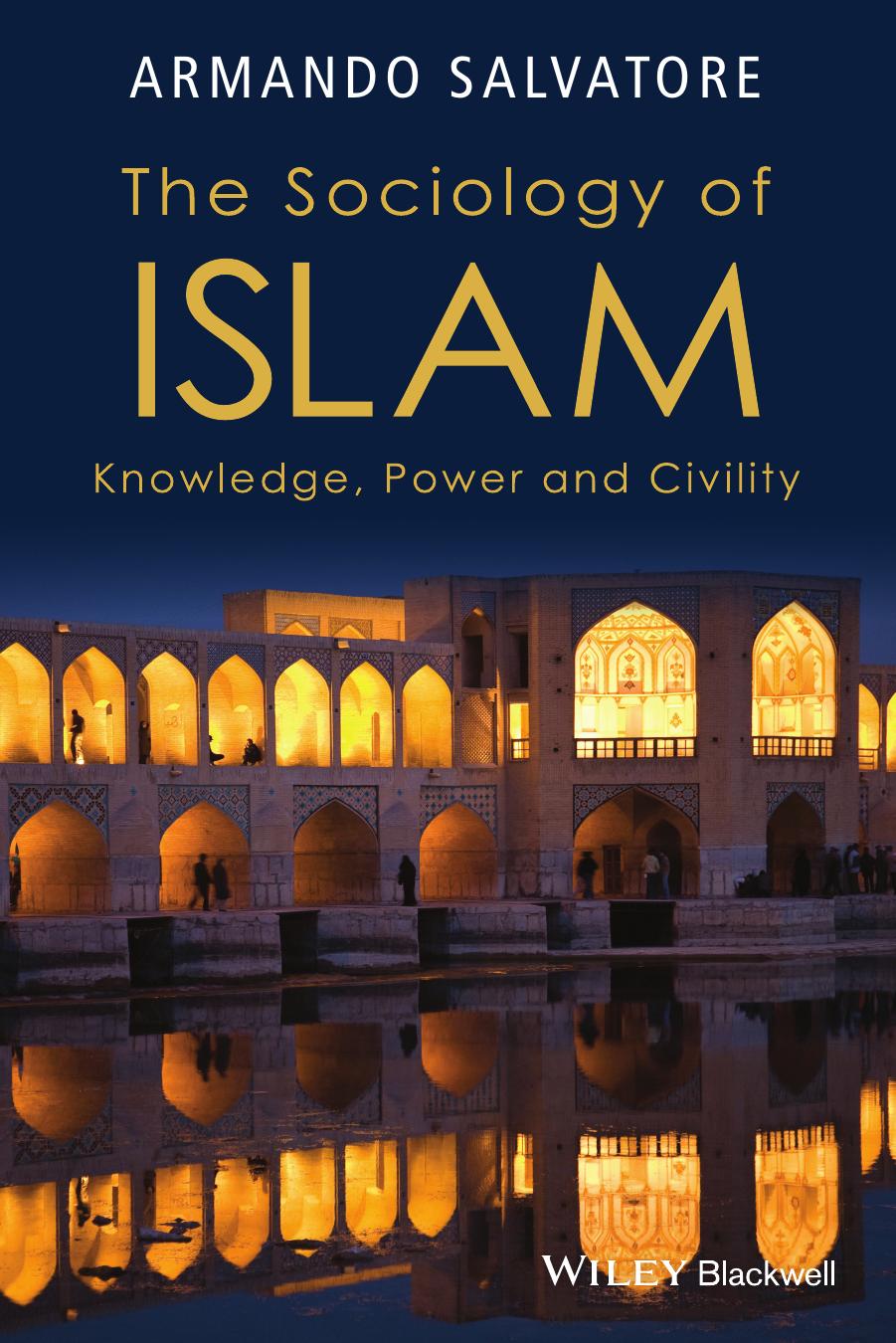
Author:Armando Salvatore
Language: eng
Format: epub, pdf
ISBN: 9781118662632
Publisher: Wiley
Published: 2016-02-22T00:00:00+00:00
While this approach can provide an Ariadne's thread for the comparative path that still needs to enliven the sociology of Islam, a bolder approach that puts a premium on an Islamic perspective can be developed by considering Gellner's understanding of the Islamic (Khaldunian) model of civility as a kind of Platonism 2.0 that develops and subverts, by way of an antithesis, the original Platonic vision of a rational republic governed by philosophers. According to Gellner, the idea of a rationally governed city or republic which for long remained a utopian horizon in Western thought and political imagination was effectively implemented, in a strongly altered form, within Islamic society (Gellner 1981: 17–28).
Gellner's idea is premised on splitting civility into two almost opposite components, namely the refined civilization of cultivated urban classes that favors pluralism and tolerance, and the civic virtue of puritan bourgeoisies that promotes cohesion. This distinction, which is familiar to Western political theory, is particularly important from a sociological viewpoint and should contribute to deflating the Weberian bias that favors a compact model of political autonomy and citizenship. Prior to the modern Westphalian state-society formations, efforts to match the two elements appeared too often caught in squaring the circle. In the Westphalian world, it was understood that the two components could be recomposed only through a top-down approach to government led by the knowledgeable—a remote possibility in the political world of the modern Leviathan. The spirit of revolution in the name of demos seemed at best able to secure an unstable balance between the two components of civility, whereby freedom and tolerance were permanently threatened by civic and republican zeal. This was the view, highlighted by Gellner, of a liberal 18th-century thinker like David Hume (1711–1776). It can be more generally evoked as the split between liberal and republican views of political modernity.
What is nonetheless interesting in Gellner's analysis is that, in the Islamic model, tolerant urban refinement and puritan civic virtue are not only equally present but also more neatly distinct than in Western cases (Gellner 1981: 7–16). Thus while in the Western trajectory the contrast between (religious) tolerance and (religious) zeal-cum-cohesion threatens the integrity of the standards of governance and participation, in the Islamic case the two components, precisely for being more clearly distinct, are integral to a much more dynamic sociological process, at first sight identifiable with the Khaldunian cycle. Within such dynamics, the former component represented by tolerance and freedom, and related to the kernel of civility proper, is on the side of the urban refined, while civic virtue is a product of tribal ethos and particularly of its spirit of cohesion that is the true source of collective, socio-political power, namely ‘asabiyya. This quite streamlined sociological process is made possible by the fact that, free from the Western biased view of civility as being the monopoly of the city, Ibn Khaldun could identify a civilization of the nomads as matching and confronting urban civilization. According to Gellner this was not an ideational difference but
Download
This site does not store any files on its server. We only index and link to content provided by other sites. Please contact the content providers to delete copyright contents if any and email us, we'll remove relevant links or contents immediately.
The Lost Art of Listening by Michael P. Nichols(7551)
Why I Am Not A Calvinist by Dr. Peter S. Ruckman(4188)
The Rosicrucians by Christopher McIntosh(3548)
Wicca: a guide for the solitary practitioner by Scott Cunningham(3213)
Signature in the Cell: DNA and the Evidence for Intelligent Design by Stephen C. Meyer(3185)
Real Sex by Lauren F. Winner(3061)
The Holy Spirit by Billy Graham(3000)
To Light a Sacred Flame by Silver RavenWolf(2865)
The End of Faith by Sam Harris(2773)
The Gnostic Gospels by Pagels Elaine(2563)
Waking Up by Sam Harris(2494)
Jesus by Paul Johnson(2406)
Nine Parts of Desire by Geraldine Brooks(2403)
Devil, The by Almond Philip C(2367)
The God delusion by Richard Dawkins(2341)
Heavens on Earth by Michael Shermer(2312)
Kundalini by Gopi Krishna(2217)
Chosen by God by R. C. Sproul(2202)
The Nature of Consciousness by Rupert Spira(2141)
